
A Clinical Decision Framework for Healthcare Providers
When a patient presents requesting emergency contraception, the clinical conversation typically defaults to the emergency contraceptive pill (ECP). This is understandable — pills are familiar, easy to dispense, and require no procedural skill. However, for many patients, the copper intrauterine device (copper iud) is a clinically superior option — and one they are rarely offered.
This article provides a practical decision framework for gynaecologists, general practitioners, and sexual health clinicians who counsel patients on emergency contraception. It compares the two methods across efficacy, timing windows, contraindications, cost over time, and patient suitability.
Efficacy: The Numbers That Matter
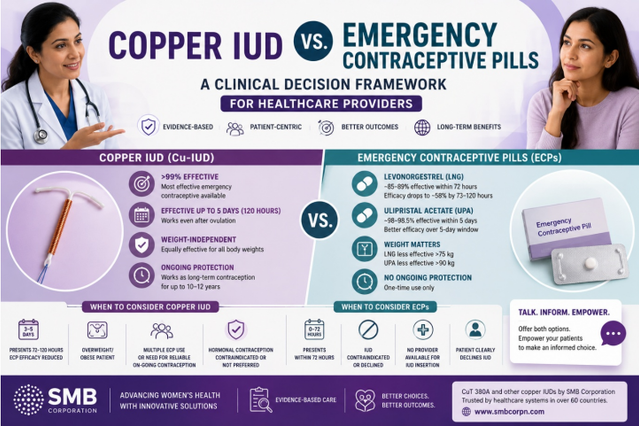
The copper IUD is the most effective emergency contraceptive available. When inserted within 120 hours (5 days) of unprotected intercourse, it reduces the risk of pregnancy by more than 99%. Some studies report failure rates as low as 0.1%, making it more than 10 times more effective than levonorgestrel (LNG) ECPs in direct comparisons.
Ulipristal acetate (UPA), the newer ECP available in many markets, has superior efficacy to LNG but still falls significantly short of the copper IUD. A systematic review published in the Cochrane Database confirmed that the copper iud is the single most effective post-coital contraceptive method available.
Key efficacy comparison: copper iud >99%, Ulipristal acetate ~98–98.5% (within 5 days), Levonorgestrel ~85–89% (within 72 hours, declining with time). Source: Cochrane Review, WHO guidance.
Timing Windows: A Critical Clinical Difference
Copper IUD
The copper iud is effective up to 5 days (120 hours) after unprotected intercourse — and importantly, efficacy does not decline significantly within this window. The device also works even after ovulation has occurred, as it creates a post-fertilisation environment hostile to implantation.
Levonorgestrel (LNG) ECP
LNG ECPs are most effective within 72 hours, with efficacy declining to approximately 58% by 73–120 hours. They work primarily by preventing or delaying ovulation and have little or no effect post-ovulation. This is a clinically significant limitation when the patient presents on day 3–5.
Ulipristal Acetate (UPA)
UPA maintains more consistent efficacy over the 5-day window compared to LNG and can delay ovulation even when the LH surge has already begun — a meaningful clinical advantage. However, it is not appropriate for women who may be breastfeeding and has drug interactions with hormonal contraceptives.
The Patient Suitability Matrix
Neither method is universally appropriate. Use the following framework to guide the counselling conversation:
Favour the Copper IUD when:
- The patient presents 72–120 hours after unprotected intercourse (ECP efficacy is substantially reduced)
- The patient is overweight or obese — LNG efficacy is significantly reduced at body weight above 75 kg; UPA at above 90 kg. The copper iud is weight-independent
- The patient wants ongoing, long-term contraception — the IUD can remain effective for up to 10–12 years
- The patient has used LNG ECPs multiple times — there is no clinical maximum, but repeated use suggests a need for more reliable ongoing contraception
- Hormonal contraception is contraindicated (e.g., history of hormone-sensitive cancer, active cardiovascular conditions in some contexts)
Favour the ECP when:
- The patient presents within 72 hours and does not want an IUD
- copper iud is contraindicated (current pregnancy, Wilson’s disease, unexplained uterine bleeding, copper allergy)
- The patient has a current STI that has not been treated — insertion should be deferred pending treatment
- No provider is available for same-day insertion and the patient cannot return within the 120-hour window
- The patient clearly declines IUD after counselling — consent is non-negotiable
Body Weight and Efficacy: An Underappreciated Issue
The relationship between body weight and ECP efficacy is a critical and commonly overlooked clinical consideration. Multiple studies and a European Medicines Agency assessment have confirmed that LNG effectiveness is significantly reduced in women weighing more than 70–75 kg. The reduction in efficacy is clinically meaningful — not a statistical footnote.
UPA has a higher weight threshold (around 90 kg) but is not immune to this effect. The copper iud has no weight-related efficacy limitation and should be the preferred option for heavier patients when clinically appropriate.
Cost-Effectiveness Over Time
The copper iud has a higher upfront cost (device + insertion procedure) compared to a single ECP course. However, a patient who uses the copper iud for ongoing contraception — as approximately 50% of patients who receive one for emergency contraception choose to do — benefits from one of the most cost-effective long-term contraceptive methods available.
For a patient who would otherwise use oral contraceptives for 5–10 years, the copper iud is less expensive over the same period, with no adherence burden and superior efficacy. This economic argument is relevant in both private practice counselling and public health resource allocation.
WHO MEC Categories for Emergency IUD Insertion
Absolute contraindications to emergency copper iud insertion are the same as for interval insertion (WHO MEC Category 4): known or suspected pregnancy, current purulent cervicitis or chlamydial or gonorrhoeal infection, Wilson’s disease, and copper allergy.
A STI screen at presentation is ideal but should not delay insertion beyond the 120-hour window if the patient is low-risk and clinically asymptomatic. The WHO guidance supports concurrent STI testing and insertion in low-risk patients.
How to Offer the IUD in an Emergency Contraception Consultation
Many women do not know the copper IUD can be used as emergency contraception. The offer must be proactive. A simple script:
“There are two main options for emergency contraception. One is the morning-after pill, which works best in the first 72 hours. The other is a small copper device called an IUD, which is actually more effective and works for up to 5 days. It can also stay in place as your main contraceptive for up to 10 years if you choose. Would you like to know more about either option?”
This framing presents both options neutrally, invites curiosity without pressure, and surfaces the IUD without making it feel like an unusual or extreme choice.
Conclusion
The copper IUD is the most effective emergency contraceptive available — and the most consistently effective across time and body weight. It is underutilised primarily because it is under-offered. Providers who routinely present it as an option alongside ECPs will improve clinical outcomes, reduce method failure pregnancies, and often provide their patients with a long-term contraceptive solution they did not know was accessible at the emergency consultation.
SMB Corporation manufactures the CuT 380A and a range of other copper IUDs distributed through healthcare systems in over 60 countries. Visit www.smbcorpn.com for product information.