
Root Canal Treatment in Australia: Where Precision Dentistry Meets the Preservation of Natural Oral Health

There is something profoundly human about wanting to preserve what is already ours. In dentistry, that principle takes on particular meaning when a tooth becomes infected or severely damaged. Rather than immediately accepting extraction as the inevitable outcome, contemporary dentistry increasingly asks a more thoughtful question: Can the natural tooth be saved?
For many Australians, the answer may be root canal treatment—a carefully planned procedure designed to remove infected or damaged pulp, disinfect the internal root canal system, seal it and restore the tooth so it can continue functioning. The Australian Dental Association describes root canal treatment as a way of repairing and saving a badly damaged or infected tooth rather than removing it.
Preserving More Than a Tooth
A natural tooth is more than an object used for chewing. It participates in a complex biological and mechanical system involving neighbouring teeth, the jawbone, gums and bite. When a tooth is extracted, the immediate problem may disappear, but another chapter begins: decisions about replacing the missing tooth and maintaining the surrounding structures.
This is why preservation has become an important philosophy within contemporary endodontics. Australian endodontic guidelines identify preservation of the natural dentition as the primary objective of endodontic treatment, while emphasising evidence-based diagnosis, treatment planning, cleaning, disinfection, filling and restoration.
A root canal is therefore not simply about eliminating pain. It is about giving a compromised tooth another opportunity to remain part of the patient’s natural smile.
Precision Begins With Diagnosis
The sophistication of modern root canal care begins before the dental handpiece touches the tooth.
A dentist or endodontist must first determine whether the pulp is irreversibly damaged or infected, understand the anatomy of the tooth and evaluate whether the tooth can realistically be restored. X-rays are an important component of this process because they help clinicians assess the tooth and surrounding structures.
This diagnostic stage matters because every tooth presents a different anatomical puzzle. Root canals can be narrow, curved or difficult to locate. Some teeth have multiple canals, while previous dental work, cracks or calcification can make treatment more complex.
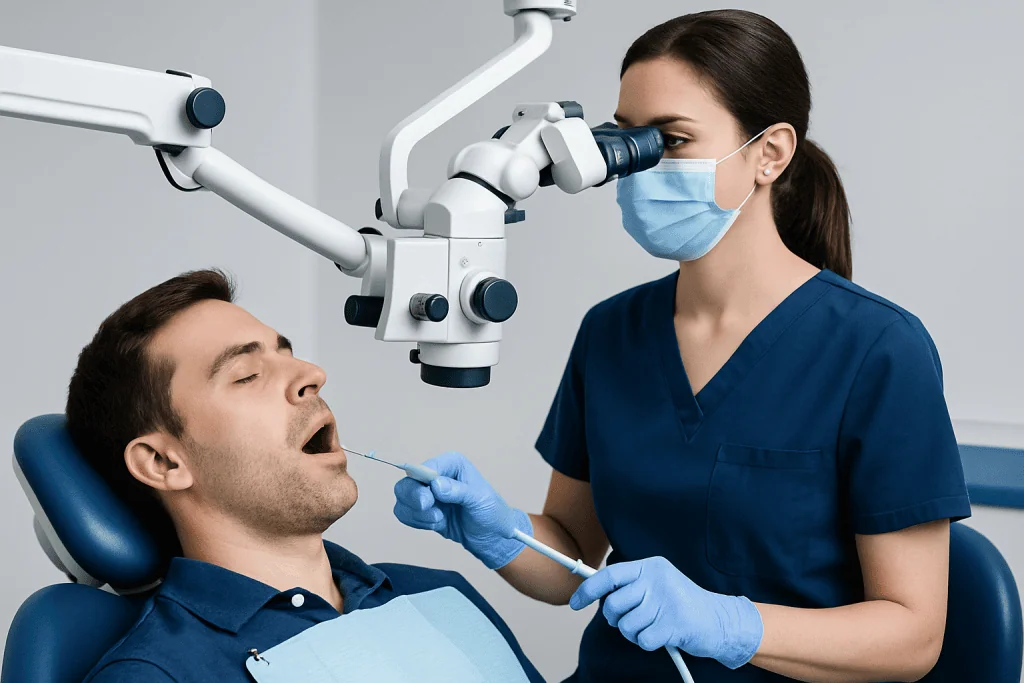
Modern endodontics consequently combines clinical judgement with increasingly sophisticated technology and techniques. Australian professional education in endodontics now covers technologies and approaches such as illumination and magnification, rotary instrumentation, advanced irrigation, three-dimensional obturation and improved sealing techniques.
Precision, in this context, does not mean using technology for its own sake. It means using the right tools to understand anatomy more clearly and treat it as conservatively and accurately as possible.
Has Root Canal Treatment Become Pain-Free?
The phrase “root canal” has accumulated decades of cultural anxiety. Yet the modern procedure is considerably different from the frightening image many people associate with it.
Local anaesthetic is used to numb the tooth and surrounding area, while isolation with a dental dam helps keep the treatment field clean and protects the patient during the procedure.
This is why modern dental clinics specialize in pain-free treatment as part of a broader patient-centred approach. The goal is not merely to perform technically successful treatment, but to make the experience as comfortable and predictable as possible.
It is important, however, to distinguish “pain-free treatment” from a promise that every patient will experience absolutely no sensation. Some people can experience tenderness or discomfort following treatment, which generally improves as healing progresses.
In other words, modern dentistry does not need to pretend discomfort is impossible. Instead, it can manage it intelligently.
What Actually Happens During Treatment?
Once the tooth has been adequately numbed and isolated, the dentist creates an opening into the pulp chamber. Diseased or infected pulp tissue is removed, and the root canals are carefully cleaned, shaped and disinfected.
The canals are then filled with a material such as gutta-percha and sealed to reduce the risk of bacteria entering the treated space again. Finally, the visible portion of the tooth is restored, commonly with a filling or, where appropriate, a crown.
The restoration is not an afterthought. A root-treated tooth can require substantial structural protection, particularly when significant tooth structure has been lost. The Australian Dental Association notes that restoring an appropriate tooth with a crown can improve its longevity, particularly for molars exposed to substantial chewing forces.
The Australian Perspective: Evidence Over Myth
Australia’s approach to contemporary endodontics reflects a broader movement toward evidence-based dentistry. The Australian Society of Endodontology has developed guidelines addressing diagnosis, case difficulty, canal preparation, irrigation, obturation, restoration and outcome assessment.
That matters because successful treatment is not simply about removing infected tissue. It is a sequence of decisions in which diagnosis, technique, infection control, restoration and follow-up all contribute to the final result.
For patients, this translates into a more sophisticated conversation with their dentist. Instead of asking only, “Will I need a root canal?”, it can be valuable to ask: *Is my tooth restorable? What is causing the problem? What are my alternatives? Will I need a crown? Should I see an endodontist?*
Protecting the Future of Your Smile
Root canal treatment ultimately represents an intriguing intersection between biology and engineering. The biological problem is infection or irreversible pulp damage. The engineering challenge is navigating an intricate internal architecture, disinfecting it and sealing it effectively. The restorative challenge is then to return strength and function to the tooth.
But beneath all that technology lies a surprisingly simple philosophy: preserve what can still be preserved.
For Australians experiencing persistent toothache, sensitivity, swelling or other signs of dental infection, timely assessment is important. Untreated infection can progress and may ultimately result in tooth loss.
Modern root canal treatment is therefore not merely a procedure associated with dental pain. It is an expression of contemporary dentistry’s commitment to precision, conservation and long-term oral health.
When technology is guided by sound diagnosis and skilled clinical judgement, saving a natural tooth is no longer an outdated ambition. It can be one of the most sophisticated forms of dentistry available: doing precisely enough to preserve something remarkably valuable—the patient’s own tooth.